Haute-Savoie
Chamonix
The valley under Mont Blanc, where alpine climbing was invented
Photo: Tiia Monto · CC BY-SA 3.0
Chamonix sits at 1,035 metres below Mont Blanc, western Europe's highest peak at 4,808 metres, and has been the centre of alpine sport since the 18th century.
The birthplace of alpinism
The first ascent of Mont Blanc was made in 1786 by Jacques Balmat and Michel-Gabriel Paccard, and the town that sponsored them became the model for mountain resorts everywhere. The Compagnie des Guides de Chamonix, founded in 1821, is the oldest guiding company in the world. The valley's climbing and skiing culture is still centred on it.
Aiguille du Midi and the high mountains
The cable car to the Aiguille du Midi climbs to 3,842 metres in two stages, one of the highest vertical ascents in the world, and gives a view directly onto Mont Blanc's north face. From there, a famous off-piste run descends the Vallee Blanche glacier, guided only. The Mer de Glace, France's largest glacier, is reached by a separate historic train and a cable car down to the ice cave.
Summer and winter
July and August are the hiking and climbing season, with the Tour du Mont Blanc passing through the valley. December to April is the ski season, with the Vallee Blanche and the Grands Montets among the classic off-piste areas. The valley is busy in both seasons; the shoulder months of June and September are quieter and still walkable.
Three things not to miss
- The Aiguille du Midi terrace at 3,842 m
- The Mer de Glace glacier from the Montenvers train
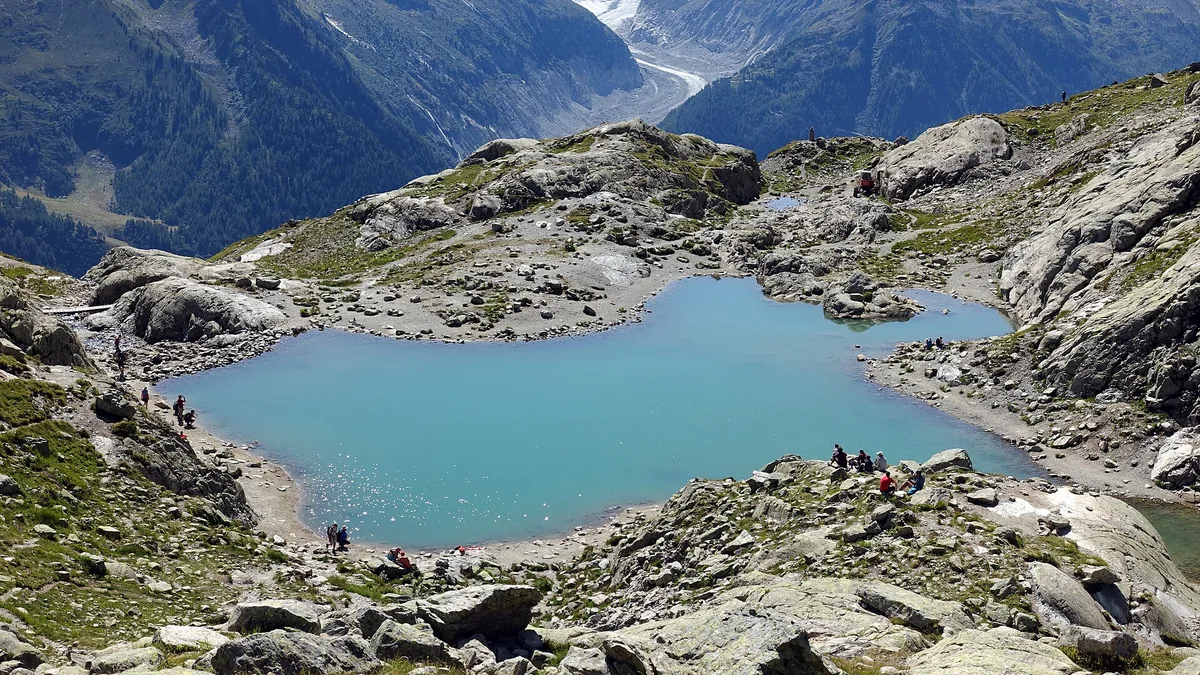
- The view of Mont Blanc from Lac Blanc, a half-day hike
In pictures
Every photo in this guide is freely licensed, credited, and available at full resolution from Wikimedia Commons.
Nearby in the atlas